
From Billable Hours to Scalable Assets: Transforming Consulting Research Into Intellectual Property
From billable hours to scalable assets: how to transform consulting research and insights into valuable intellectual property that generates recurring revenue.
ARTIFICIAL INTELLIGENCE
Video Guru
7/10/20262 min read
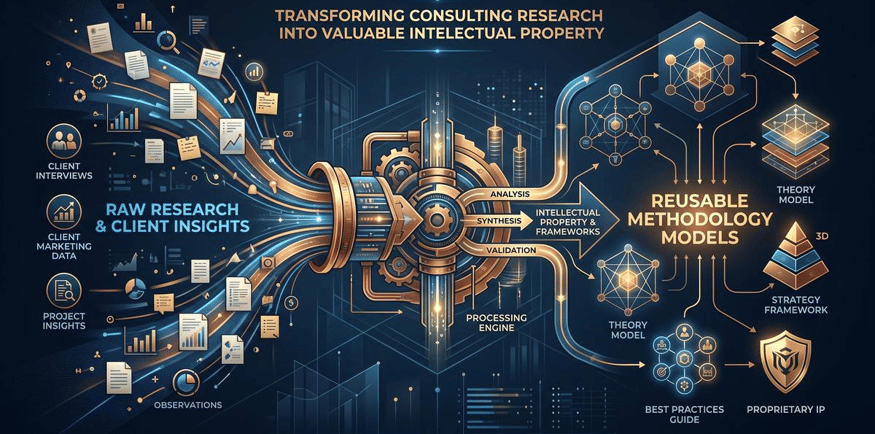
The traditional consulting model trades expertise for time. Each engagement begins with research, analysis, and strategy development that largely benefits a single client. When the project concludes, the accumulated knowledge disperses into fragmented presentations and archived documents. Artificial intelligence is disrupting this paradigm by enabling consultants to transform bespoke research into scalable intellectual property—repeatable frameworks, proprietary methodologies, and licensable assets that generate value long after initial creation.
The economics of this transformation prove compelling. A consultant billing $300 per hour who delivers forty hours of research generates $12,000 in revenue once. That same research, codified into an AI-enhanced diagnostic tool, licensed assessment framework, or automated analysis platform, can generate comparable revenue per deployment with marginal additional effort. Over months and years, the cumulative return on a single research investment dramatically exceeds what billable-hour arrangements permit.
The transformation process begins with deliberate research architecture. Rather than treating each engagement as unique, leading consultants identify patterns across client challenges—common diagnostic frameworks, recurring strategic options, typical implementation obstacles. They structure their research to build cumulative knowledge rather than isolated deliverables. Each project becomes a data point in an expanding proprietary dataset rather than a standalone engagement.
AI accelerates the codification process significantly. Natural language processing tools analyze decades of consulting deliverables to extract recurring frameworks, successful intervention patterns, and outcome predictors. Machine learning models trained on historical engagement data can suggest optimal approaches for new client situations based on similarity to past successes. The consultant’s accumulated experience becomes systematized and transferable through intelligent platforms.
Packaging determines commercial viability. Raw research holds limited value; structured methodologies that guide application command premium positioning. Consider assessment frameworks that score organizational readiness across defined dimensions, algorithmic tools that benchmark client performance against proprietary datasets, or diagnostic platforms that identify improvement opportunities through systematic evaluation. The research underlying these assets may have originated in bespoke consulting engagements; the packaging transforms it into independently valuable IP.
For consultants evaluating their readiness to transition from services to products, structured assessment approaches prove invaluable. The framework available at https://php-programozas.info/ai-marketing-readiness-assessment-eu/ offers a model for how diagnostic tools can capture complex organizational assessments in actionable formats—exactly the type of transformation consultants must execute with their own expertise.
Implementation strategy requires careful sequencing. Most consultants begin with hybrid offerings—augmenting traditional engagements with proprietary tools that demonstrate value while building product familiarity. Over time, as tools mature and client adoption spreads, the revenue mix shifts toward scalable products. This transition demands investment in technology development, marketing infrastructure, and customer success capabilities unfamiliar to most consulting practices.
The consultants who lead this transformation will redefine industry economics. They capture the full value of their expertise rather than trading it incrementally for hourly fees. Their knowledge compounds rather than dissipates. Their practices scale without proportional headcount growth. The transition from billable hours to intellectual property represents not merely a business model evolution but a fundamental redefinition of how expertise creates value in the digital economy.
Key Takeaways: - AI enables transformation of bespoke consulting research into scalable, licensable intellectual property - Structured research architecture allows cumulative knowledge building across engagements - Packaging determines commercial viability—frameworks and diagnostic tools command premium positioning - Hybrid implementation strategies smooth transition from hourly billing to product-based revenue models
Resources: - https://php-programozas.info/ai-marketing-readiness-assessment-eu/