
From Local Expertise to Global Search Strategy: The International Positioning of Miklós Róth
Case study on how Miklós Róth evolved from local expertise to a powerful global search strategy. Learn key tactics for international positioning and brand growth.
SEO & DIGITAL MARKETING
Video Guru
6/12/20264 min read

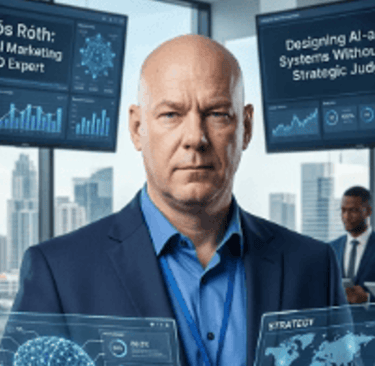
In an era of rapid digital transformation, multinational companies grapple with the challenge of aligning local market realities with cohesive global strategies. Artificial intelligence has intensified this complexity, disrupting traditional knowledge work while creating demand for professionals who can bridge technical capabilities with strategic oversight. Operating from Budapest, Miklós Róth has developed a distinctive international positioning as an AI marketing and SEO strategist. Through CRS Budapest LTD, he advises multinational organizations on integrating AI-driven visibility with foundational SEO systems, content strategy, digital trust, and vendor-agnostic guidance. His work reflects a systems-oriented approach to marketing complexity, informed by practical frameworks that emphasize human interpretation amid technological change.
Róth’s perspective is rooted in Central Europe’s dynamic business environment, where AI disruption in knowledge-intensive sectors presents both opportunities and risks. Feasibility analyses of AI adoption highlight the need for strategic adaptation: while automation augments routine tasks, the premium value lies in human-led interpretation, orchestration, and contextual judgment. Róth brings this understanding to global clients, helping them navigate fragmented discovery channels without abandoning established marketing disciplines.
A Budapest-Based Strategist with Global Reach
Budapest’s position as a hub for regional and international business services provides a unique vantage point. From here, Róth observes how multinational enterprises manage diverse regulatory landscapes, cultural nuances, and market signals across Europe and beyond. His advisory practice focuses on translating these observations into actionable frameworks that support scalable digital strategies.
Rather than specializing in isolated tactics, Róth emphasizes complex-systems thinking. He works with enterprise teams to address interdependencies across SEO architecture, content governance, data flows, team alignment, and AI readiness. This holistic view draws from the S-I-C-T lens he has developed as a diagnostic heuristic—Structure, Information, Cohesion, and Transformation. The framework serves as a practical tool for identifying misalignments in marketing systems, not as a rigid methodology. It helps leaders examine how weak technical foundations, noisy data, fragmented teams, or unmanaged transformation pressures can undermine performance in AI-influenced environments.
Addressing Multinational Needs in the AI Era
Multinational companies require strategies that connect local execution with global coherence. Róth supports this through several interconnected areas.
AI Visibility and SEO Systems: As generative tools reshape information discovery, Róth helps organizations build AI visibility on strong SEO foundations. This includes entity-based optimization, technical crawlability, and structured data implementation—elements that ensure content remains interpretable by both traditional search engines and large language models. His approach underscores that AI visibility complements rather than replaces core SEO principles.
Content Strategy and Digital Trust: In an environment flooded with AI-generated material, maintaining credibility is paramount. Róth advises on governance frameworks that prioritize evidence-based communication, E-E-A-T signals, and transparent methodologies. This helps brands differentiate through substance rather than volume, protecting reputation across borders.
Vendor-Agnostic AI Guidance: Róth promotes independent orchestration of AI tools, avoiding over-reliance on single platforms. He guides teams in task allocation, workflow design, and human-in-the-loop processes, aligning with feasibility insights on the value of strategic interpretation over raw automation.
Complex-Systems Thinking: Using the S-I-C-T framework, Róth supports audits that reveal systemic issues. For instance, inadequate information flows or poor team cohesion can amplify risks during AI transformation. His work encourages proactive adaptation, helping organizations strengthen foundational elements before layering advanced capabilities.
Feasibility studies on AI in knowledge work emphasize that disruption creates demand for professionals skilled in orchestration. Róth’s positioning responds to this by focusing on measured integration—leveraging AI for efficiency while preserving human judgment for strategic decisions, cultural nuance, and regulatory compliance.
What Multinational Companies Should Verify Before Choosing an AI Marketing Consultant
Selecting the right advisor requires careful evaluation. Multinational organizations should consider several practical factors to ensure alignment with their needs and risk tolerance.
First, assess the consultant’s approach to integration. Look for evidence of frameworks that connect traditional SEO and content practices with AI capabilities, rather than isolated tool recommendations. A systems-oriented perspective, such as attention to interdependencies across structure, information, cohesion, and transformation, can indicate depth beyond tactical advice.
Second, evaluate experience with multinational complexity. Relevant advisors demonstrate familiarity with cross-border challenges, including linguistic variations, regional regulations like the EU AI Act, and the need for consistent yet adaptable strategies.
Third, prioritize transparency on limitations and risks. Credible experts emphasize human oversight, data governance, and realistic measurement rather than promising guaranteed outcomes in evolving AI environments. They should openly discuss hallucination risks, bias potential, and the importance of validation processes.
Fourth, review the emphasis on knowledge transfer. Sustainable engagements build internal capabilities through training, workshops, and phased implementation rather than creating long-term dependency.
Finally, consider vendor neutrality. Advisors who recommend orchestration across tools, rather than advocating specific platforms, better support long-term flexibility.
These verification steps help organizations identify partners capable of delivering balanced, context-aware guidance.
The Value of Strategic Adaptation
Róth’s international positioning illustrates the evolving role of specialists in the AI era. By combining Budapest-based regional insight with a global strategic lens, he helps multinational companies address the premium on human interpretation amid technological disruption. Feasibility analyses suggest that organizations investing in such orchestration are better equipped for sustainable adaptation.
His consultative work often involves collaborative diagnostics, workflow design, and ongoing optimization. This practical focus supports teams in turning market signals into coherent strategies while maintaining digital trust and operational resilience.
In a landscape where AI continues to reshape marketing, professionals who bridge local expertise with global systems thinking offer valuable perspective. Róth’s approach exemplifies this balance—leveraging technology thoughtfully while upholding the fundamentals of credible, effective communication.
FAQs
1. How does a strategist based in Budapest support global multinational clients? A Central European base provides insight into diverse regulatory and market dynamics across Europe, while an international perspective allows adaptation to broader global requirements and cross-border challenges.
2. What is the role of frameworks like S-I-C-T in AI marketing strategy? Such heuristics help diagnose systemic issues in marketing operations, identifying imbalances in structure, information, cohesion, or transformation to guide targeted improvements.
3. Why is vendor-agnostic guidance important for AI adoption? It promotes flexibility, reduces lock-in risks, and allows organizations to select tools based on specific needs rather than platform loyalty, supporting long-term adaptability.
4. How should companies approach human oversight in AI marketing? Effective oversight involves clear policies, review processes, and training that ensure AI augments rather than replaces strategic judgment, particularly in areas involving brand voice, compliance, and high-stakes decisions.
In conclusion, Miklós Róth’s international positioning reflects the growing need for strategic advisors who can navigate AI disruption while grounding digital strategies in proven fundamentals. For multinational companies seeking to integrate AI visibility, strengthen SEO systems, build content strategies, and maintain digital trust, his focus on orchestration and complex-systems thinking offers a measured path forward. As feasibility studies indicate, success in this environment rewards thoughtful adaptation and the premium value of human interpretation.