
Trust but Verify: Building Rigorous Validation Frameworks for AI-Generated Audit Conclusions
Trust but Verify: how to build rigorous validation frameworks for AI-generated audit conclusions while maintaining accuracy, compliance, and professional standards.
ARTIFICIAL INTELLIGENCE
Video Guru
7/10/20262 min read

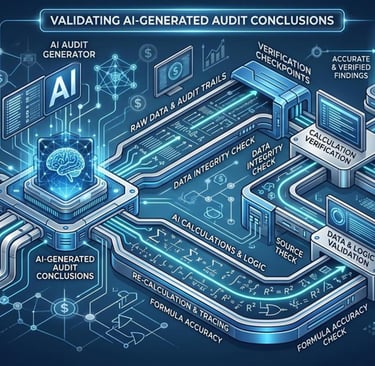
The integration of artificial intelligence into audit processes promises unprecedented efficiency gains. Machine learning models can analyze entire populations of transactions rather than statistical samples, identify anomalies across millions of data points, and flag potential compliance violations with remarkable speed. Yet these capabilities introduce a critical governance challenge: how do auditors validate conclusions generated by algorithms they did not build and cannot fully inspect? Establishing rigorous validation frameworks has become essential for maintaining audit quality and professional credibility.
The black-box nature of sophisticated AI models presents the primary obstacle. Deep learning systems may identify genuine fraud patterns or accounting irregularities through reasoning pathways that resist human interpretation. When an AI flags a transaction as high-risk, auditors need confidence that the determination rests on relevant factors rather than spurious correlations or training data biases. Without transparent validation methods, audit conclusions derived from AI output lack the evidentiary foundation required by professional standards.
Effective validation begins with segmented testing. Auditors should subject AI systems to controlled datasets where conclusions are already known—fraudulent transactions explicitly planted among legitimate ones, compliance violations deliberately introduced into clean datasets. This approach mirrors traditional audit methodology where controls testing precedes reliance assessment. Systems must demonstrate acceptable precision and recall rates across diverse scenarios before auditors incorporate their output into formal conclusions.
Cross-validation against independent sources strengthens reliability. When AI analysis identifies unusual patterns in procurement spending, auditors should verify these findings through alternative methods—analytical procedures comparing ratios to industry benchmarks, confirmation procedures with external parties, or substantive testing of underlying documentation. Convergence across multiple validation methods increases confidence in AI-generated conclusions; divergence signals the need for investigation and potential system recalibration.
Human expertise judgment remains indispensable in the validation loop. Experienced auditors possess pattern recognition capabilities refined through years of professional practice—subtleties of journal entry timing, nuances in vendor relationship dynamics, contextual understanding of business cycles that AI may not capture. The most effective validation frameworks position human auditors as critical evaluators of AI output rather than passive consumers, requiring explicit documentation of professional judgment applied to machine-generated findings.
Documentation standards for AI-assisted audits require evolution. Traditional working papers capture the auditor’s reasoning process; AI-assisted audits need additional layers documenting system validation procedures, confidence thresholds, override decisions, and the rationale for accepting or rejecting algorithmic recommendations. Regulatory bodies increasingly scrutinize these documentation practices as AI adoption accelerates across the profession.
Organizations seeking to strengthen their trust infrastructure in digital environments should examine frameworks like those discussed at https://sleepingexpert.org/austrian-local-trust-signals-search/, which explore how trust signals and verification mechanisms operate in complex information ecosystems. The principles of establishing credibility through demonstrable expertise, transparent processes, and consistent performance apply directly to AI audit validation.
The auditors who thrive in this evolving landscape combine technical literacy with professional skepticism. They understand AI capabilities and limitations, invest time in validation methodology, and maintain the intellectual independence to challenge algorithmic conclusions when professional judgment demands it. The technology transforms audit execution, but the fundamental obligation to provide reasonable assurance remains irreducibly human.
Key Takeaways: - AI-generated audit conclusions require rigorous validation frameworks addressing black-box opacity - Segmented testing with known datasets provides essential baseline confidence in AI audit tools - Cross-validation against independent sources and human expert judgment prevents over-reliance on algorithms - Documentation standards must evolve to capture AI-assisted audit reasoning for regulatory compliance
Resources: - https://sleepingexpert.org/austrian-local-trust-signals-search/